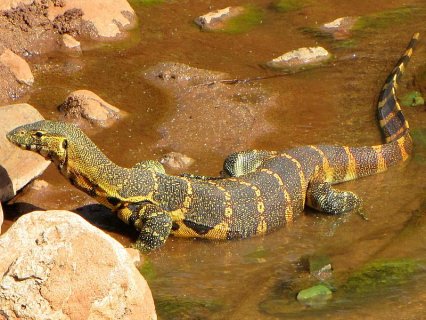
Florida monitor lizards
Between wildlife-eating Burmese pythons, colonies of poisonous lionfish, and drain-clogging hydrilla plants, the negative influence of Florida’s exotic pet and aquarium trade seems to know no bounds.
But officials at Florida’s Fish and Wildlife Conservation Commission are hoping this spring is marked by the eradication of one sinister-looking, five-foot-long invasive species—not the establishment of a new one.
Nile monitor lizards, native to Africa, are just starting to gain a foothold in South Florida’s Palm Beach County. Around 50 sightings have been verified, and wildlife officials are increasing patrols in the region this month, betting that as the animals emerge to breed, rangers will be able to spot, catch, and kill them.
Since July 2014, wildlife officials have removed 20 Nile monitors from the area, and there are concerns the animal could be preying on everything from house cats to vulnerable native species, such as the endangered Key Largo wood rat.
So far, biologists have noted that Nile monitors appear to favor eggs, but it seems almost any fare is fair game for the reptiles.
“Nile monitors eat a wide variety of food items, including small mammals, reptiles, fish, amphibians, and more, ” Florida biologist Jenny Ketterlin Eckles said in a statement. “Because their diet is so varied, we are assessing whether this species may have an impact on Florida’s native wildlife.”
Spring patrols are being increased from once a month to four to six times a month. Additionally, officials are asking citizens to report and take photos of any Nile monitor lizards they spot but not to try to catch them. The Jurassic-looking lizards are typically not dangerous, but they can be if they feel threatened.
Officials believe the West Palm Beach lizard population is small enough that there is a reasonable chance the region’s population could be eliminated.
But in other regions of the state, it’s a different story. Nile monitor lizards have been in Florida since the 1990s, becoming well established in Lee County, along the state’s west coast, where more than 600 sightings have been reported. Biologists suspect that like most of Florida’s unwanted exotic species, Nile monitors were introduced as either escaped or released pets.
You might also like